
Most of what we post here focuses on long-range pipeline inspection with the MsS encircling probe (LRUT) — but that's only about half of what the MsS system does.
The other half is short-range ultrasonic testing (SRUT) with the MsS sector probe, covering pipeline and plate structure applications including:
- High-sensitivity inspection of 16-inch-OD and larger pipeline
- Inaccessible locations: soil-to-air interface, wall penetrations
- Pipe support inspection
- Tank wall inspection
- Pressure vessel inspection
- Thick plate inspection
- Corrosion mapping on pipe and plate structure
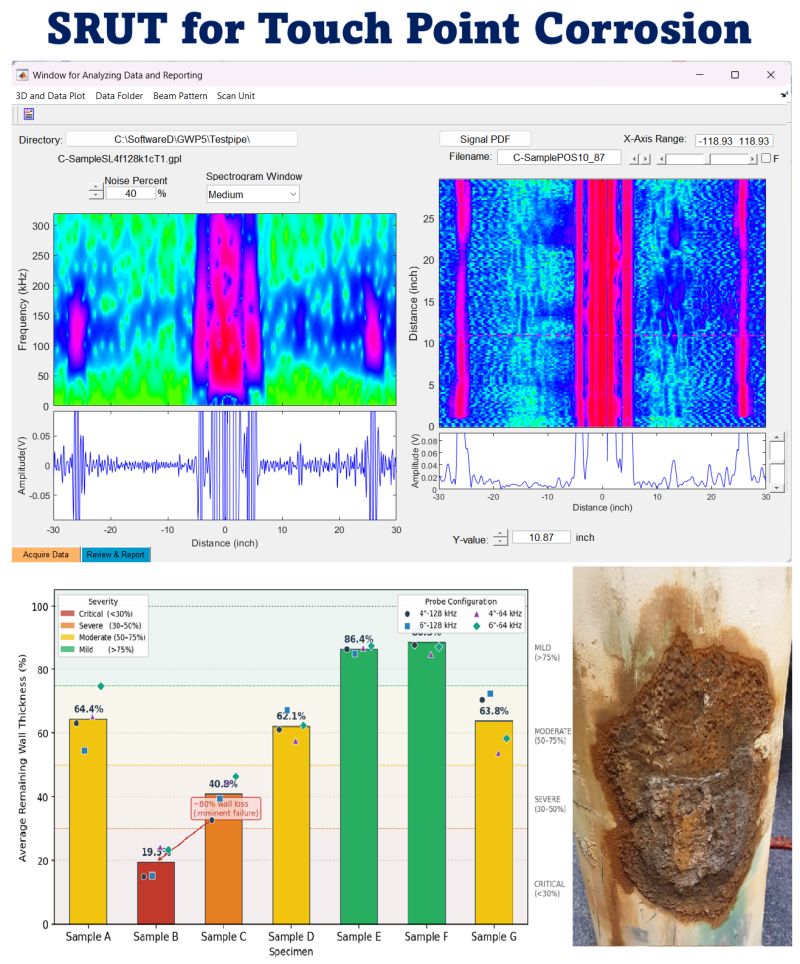
This image shows the full SRUT analysis workflow for touch-point corrosion: the GWP software screen (spectrogram, distance-domain signal, and amplitude plot), severity results across seven test samples using four different probe/frequency configurations for cross-validation, and the actual corrosion found at Sample C — 40.9% average remaining wall thickness (Severe range).
Touch-point corrosion was one of the topics that generated the most questions on our poster session
at NDT Canada 2026.
How do you actually inspect it using guided wave technology?
We've published the full paper, Touch-Point Corrosion Inspection of PipelinTouch-Point Corrosion Inspection of Pipeline Supports Using High-Frequency MsS Sector Probe Guided Wave Testing.
And a demonstration video covering the method.
The video walks through the full workflow — hardware setup, live scan, signal interpretation, and PDF report generation — on a quarter-inch steel plate with four known defects, no coating removal required.